
Our Forum
Art and Making:
Material Culture, Craft and Emerging Practices
Date: 4 March 2026
Venue: British Museum
BP Lecture Theatre & East Foyer
Organiser: Asian Academy of Arts
Attendance: 78
Media coverage: 2000+
As seen on:
🔗 United States — Digital Journal
🔗 United States — Yahoo Finance
Chief Curator: Fang Ting Ting
Event Coordination: Wen Shaoyue
Executive Director: Yang Jie
On-site Coordination: David Shi
Academic Advisor: Zhao Jun
Production Team: CJcaptain, Hou Yajie, Roland Min, Shan Linhao
Guest Assistants: Wen Xuanhe, Chen Sangyu, Min Yueying, Cai Qingjuan, Cheng Qianyang, Qian Lumin
Poster Design: Liu Jiachen
Online Coordination: He Ziming, Chang Zeqi
Video Production: Bruce Huang
Photography: FeiLing Peng
Asian Academy of Arts Hosts Art and Making Forum at the British Museum, London
On 4 March 2026, the invited academic forum “Art and Making: Material Culture, Craft and Emerging Practices”, organised by the Asian Academy of Arts, was successfully held at the British Museum BP Lecture Theatre and East Foyer in London.
The forum centred on three key themes—material, craft, and cross-cultural translation—exploring how contemporary practitioners position their work between traditions of material culture and the conditions of globalisation. Particular attention was given to emerging artists and researchers investigating the relationships between materials, symbols, and identity.
Opening Remarks
In her opening remarks, Fang Ting Ting, Dean of the Asian Academy of Arts, noted that the event was not intended simply to present differences between artistic practices, nor to categorise art, craft, and design into separate disciplines.
Instead, the forum was organised around a more fundamental question: can “making” be understood as a form of knowledge production within contemporary art?
Over recent decades, Fang observed, contemporary art discourse has increasingly emphasised concepts and theoretical texts, while materials and processes of making have often been treated as merely technical execution. Yet when artists interact with materials—responding to their resistance, feedback, and transformation—thinking itself may emerge through that process.
If practice is itself a mode of thinking, Fang suggested, then the position of making within the contemporary art system may need to be reconsidered.
She further noted that discussing this question within the context of a museum—an institution fundamentally centred on objects—introduces a particular intellectual tension. Objects are not merely historical remnants; they carry knowledge, memory, and structures of power.
Fang therefore proposed three guiding questions that shaped the discussions throughout the forum:
• Does making generate thought?
• Do objects generate meaning?
• Do long-standing hierarchies within the art system shape how different practices are interpreted?
These questions, she emphasised, were not intended to create opposition between disciplines, but to provide a clearer understanding of the structures within which contemporary practices operate.
Roundtable I
Emerging Practices Across Generations
The first roundtable discussion was moderated by Vivian Ni, cultural advisor and founder of West Link Consulting, and brought together speakers from museums, academia, and curatorial practice.
Helen Wang — Objects as Sites of Knowledge Production
Former East Asian coin curator Helen Wang drew on her long curatorial experience at the British Museum to discuss how historical objects can function as sites of knowledge production.
Using examples from numismatic collections and inscriptions, she demonstrated how material artefacts serve not only as historical records but also as primary evidence of cultural encounters.
She also reflected on the evolution of research methods in projects such as the International Dunhuang Project, recalling how scholarly access has transformed from microfilm archives to digital photography. While digitalisation has dramatically expanded access to collections worldwide, it also introduces new challenges: as knowledge spreads, demand to encounter original objects grows, creating ongoing tension between access and conservation.
One example she highlighted was a complex wooden printing block once used to produce banknotes. The object consisted of multiple detachable components designed to prevent counterfeit reproduction. At once a practical tool and a work of extraordinary craftsmanship, the object demonstrated how technical innovation, economic history, and aesthetic skill can converge within a single artefact.
Frances Wood — The Contemporary Value of Making
British sinologist and historian Frances Wood continued the discussion by reflecting on the contemporary relevance of making.
She described the word itself as deeply resonant, emphasising that making has always been central to human activity. Today, however, digital platforms such as YouTube and social media allow unprecedented visibility into the processes through which objects are created.
Wood raised a central question: how do we assign value to things that are made?
In her view, a work succeeds when it fulfils the intention of its maker—something ultimately understood most clearly by the artist themselves. Whereas in earlier decades a small number of institutions or publications could define what counted as “new art,” today the sheer abundance of information makes quality judgement far more complex.
The crucial challenge, she argued, is learning how to recognise quality amid an overwhelming quantity of production.
Iris Yau — Material Histories and Power Structures
Curator and academic Iris Yau, Programme Leader at the University of the Arts London, explored the relationship between materials and global power structures.
In contemporary artistic exchange, she noted, materials carry layered histories of trade, negotiation, and cultural exchange. Materials are never neutral; they acquire meaning through global circulation and the hierarchies embedded within cultural systems.
For emerging practitioners, the challenge lies in working within this complexity—acknowledging historical weight without reducing materials to simple symbols. Instead, artists must allow materials to speak within the creative process, rather than merely illustrating predetermined ideas.
Dr. Xiaoxin Li — Methodological Shifts in Contemporary Chinese Craft
Xiaoxin Li, Curator of Chinese Collections at the Victoria and Albert Museum, addressed structural questions concerning how different forms of practice are understood within contemporary art.
Drawing on her curatorial experience with exhibitions on contemporary Chinese studio craft, Li observed a generational shift: younger practitioners are increasingly less concerned with presenting a fixed notion of “Chineseness” and more focused on material experimentation, making processes, and global dialogue.
Their central challenge, she suggested, lies in developing distinctive methodologies through which making itself becomes a vehicle for thought.
Keynote Lecture
Lu Ying — Jewellery as Cultural Translation
Following an afternoon break, the forum continued with a keynote lecture by jewellery artist and designer Lu Ying.
Lu is the founder of Oriental Naturalism Jewellery and Baoji Jewellery. Her practice integrates French craft traditions with Eastern aesthetic structures through the development of a 1668°C titanium forging technique, forming the basis of her “Nouveau Deco” aesthetic framework.
In her lecture, Lu approached jewellery not simply as decoration or craft but as a situated artistic practice.
Because jewellery is worn on the body, she argued, it functions as a close-range cultural language, capable of generating meaning through everyday experience.
Discussing materials such as titanium and moonstone, as well as historical decorative traditions, Lu demonstrated how materials carry embedded histories of technology, cultural memory, and aesthetic philosophy.
She also reflected on how her work is received across different cultural contexts, suggesting that complete understanding is not necessary for meaning to emerge. Instead, meaning arises through bodily experience, the act of wearing, and perceptual participation.
As she summarised:
“Wear, rather than explain. Let the work speak through the body, and allow each viewer to interpret it in their own way. Jewellery can become a form of cultural translation in motion.”
Roundtable II
Cross-Cultural Imagination and Emerging Curatorial Positions
Following the keynote lecture, the forum moved into the second roundtable discussion. Moderated by Vivian Ni, the conversation continued to build on the central questions proposed by Tingting Fang: in cross-cultural contexts, how might making function as a mode of thinking? How do practitioners in different positions understand the relationship between materials, institutions and the production of meaning?
Viv Lawes | Positionality, Hierarchies and Cross-Cultural Writing
Viv Lawes is a writer, journalist, lecturer and curator with over twenty-five years of experience in the art market. She is currently Head of the Art History Certificate Programme at Sotheby’s Institute of Art, and also teaches at University of the Arts London, City and Guilds of London Art School, SOAS University of London, and Imperial College London.
Lawes centred her remarks on the concept of positionality, responding to the earlier discussion of hierarchies within the global art world. She reflected on the uncertainty she once felt when researching Southeast Asian modern and contemporary art, questioning whether someone who had never lived in the region could meaningfully interpret its cultural production. The idea of positionality, she explained, provided clarity: it requires acknowledging one’s own standpoint. Speaking as a British scholar trained within Western academic systems, she argued that openly stating where one speaks from allows for more honest cross-cultural dialogue while maintaining a commitment to ongoing learning.
She also noted that what is often described as the “international art system” remains largely structured around Western institutions, which can result in other regions being labelled as “emerging” according to Western standards. Rather than viewing cultures as fixed categories, she suggested understanding them as networks of connection. Drawing on a metaphor from a display of a rabbit’s nervous system in the exhibition Body Worlds, she described cultural exchange as a web of connections rather than a single identity—where the most meaningful developments occur through interaction and accumulation over time. For Lawes, authenticity lies in acknowledging one’s position while remaining open to dialogue across cultures.
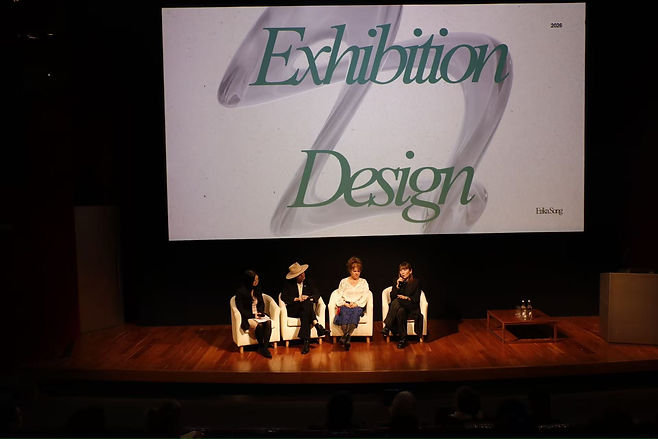
Erika Song | Identity Emerging Through Practice
Erika Song is a contemporary art curator and producer currently pursuing a PhD in Art, Design and Museum Studies at University College London. Her research examines exhibition design as a curatorial methodology, and she also serves on the editorial board of the Journal of Visual Culture.
Song’s remarks reflected on the complexity of cross-cultural identity through her own experience of studying abroad from a young age. Moving to the United States at fourteen, she recalled how many international students attempted to assimilate into American culture—adopting accents, following American sports and popular media. Over time, however, she realised that this process often produced a sense of displacement, where one becomes neither fully part of the adopted culture nor entirely connected to the original one.
Through her curatorial work supporting emerging artists, Song came to believe that the central question is not assimilation but voice. Identity, she suggested, should not be understood as a fixed cultural category but as something that gradually emerges through practice. Drawing on examples from Islamic art and architecture, including the hybrid architectural forms of Hui mosques in China, she emphasised that cultures have always evolved through exchange and movement. What matters most, she concluded, is finding one’s own position and allowing personal experience, inheritance and perspective to emerge through the act of making.
Luyang Zou | Technology, Materiality and Slow Practice
Luyang Zou is a new media artist and former architect, currently a visiting lecturer at University College London. His practice explores the intersections of computational processes, material strategies and spatial construction, working with technological frameworks ranging from code to ephemeral media such as light and sound.
Zou approached the forum’s central question from the perspective of new media practice. For him, cross-cultural experience is less a deliberate strategy than a condition of contemporary artistic life. As a Chinese artist who began his practice while studying in London, his work naturally integrates the influences of different cities, languages and cultural environments rather than consciously negotiating between them.
Working primarily with technologies such as artificial intelligence, coding and digital media—tools largely developed within Western media art traditions—he has nevertheless observed that elements related to his own background have gradually surfaced in his work. Concepts associated with Daoist philosophy, such as wu wei, as well as sensibilities linked to Chinese painting traditions, have emerged organically rather than being intentionally inserted. For Zou, this illustrates how artistic identity is not predetermined but slowly revealed through practice: rather than focusing on cultural categories, artists should concentrate on making the work they feel compelled to create, allowing their position to appear through the process itself.




(Fang Ting Ting )
(Helen Wang)
(Frances Wood)
(Iris Yau)
(Dr. Xiaoxin Li)
(Lu Ying)
(Viv Lawes)
(Erika Song)

(Luyang Zou)

(Asian Academy of Arts Team)


